
CAP Foundation Takes the Global Stage
When Dr. Richard Bowman first began working on the OpenFlexure Microscope, he wanted to answer a simple question: could a high-quality, automated microscope be made using affordable tools and materials that were widely available? By the time Dr Joe Knapper joined the team three years later, the questions had become bigger: “How many people has this already reached? How many opportunities had been created? And what could this technology do for global health?” What started as an experiment has grown into a much broader project. Today, the 3D-printed microscope is being explored for applications in pathology, education, research and remote microscopy in more than 70 countries.
The CAP Foundation first shared Dr. Knapper’s work in 2024, when he and pathologists Daniel Rosen, MD, FCAP and Kelsey Hummel, DO, FCAP, received a CAP Foundation Global Pathology Development Grant to bring the technology to the University Teaching Hospital of Butare in Rwanda. There, the team demonstrated how locally manufactured microscope components could support telepathology, training, and more accessible diagnostic care.
Now, this work is reaching new audiences.
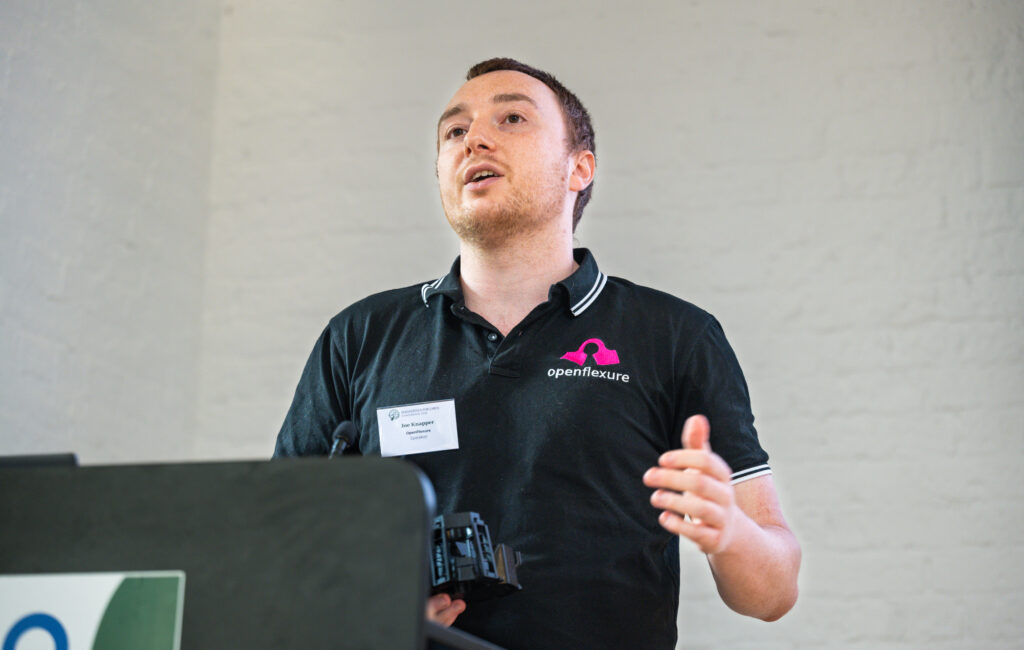
Dr. Knapper recently presented the team’s work at the Diagnostics for Low and Middle-Income Countries (Dx4LMICs) Conference at Reuben College, University of Oxford. The conference brings together researchers working to develop and deploy diagnostic tools for underserved communities. This year’s theme, Diagnostics for a Changing World, explored challenges ranging from climate-resilient diagnostics to data sovereignty.
The Foundation was proud to sponsor this year’s conference, and our connection to it originally began with our podcast.
Dr. Runjan Chetty, a guest on the Foundation’s Beyond the Test: Connecting Communities in Pathology podcast, introduced the Foundation to the work being done through Dx4LMICs and Reuben College. That introduction led to a relationship with the college that bloomed into a sponsorship.
For Dr. Knapper, the opportunity was another chance to connect with researchers, students, and potential collaborators, sharing ideas with other innovators aiming to make pathology more accessible
More Than a Microscope
If you’re not a pathologist, it can be difficult to understand what makes a 3D-printed microscope significant.
“The OpenFlexure Microscope is a miniaturized slide scanner that you can 3D-print, assemble, and control with software. It needs no specialized facilities or training, runs off a portable power bank, and has the resolution to resolve images of cancer, malaria and much more.” Dr. Knapper explains.
The hardware, software, and designs are openly available, meaning the microscope can potentially be manufactured, adapted, and maintained locally. That could make high-quality microscopy more accessible in places where conventional equipment is expensive, difficult to maintain, or dependent on complicated supply chains.
At Reuben College, attendees were curious about what that could mean for pathology. Conversations explored potential uses in education and training, research, and remote pathology.
“The response was very positive, and there was a lot of curiosity about both the technology itself and what it could enable in pathology,” Dr. Knapper says.
What was most encouraging was seeing people think beyond the microscope itself and consider what could be built around it.
“Joe’s talk generated a great deal of interest. Being able to pass around some of the 3D-printed components really brought the OpenFlexure project to life, and it was great to see the conversations continuing into the break afterwards. Joe also joined our afternoon panel discussion, which gave us an opportunity to explore some of the wider questions around developing and deploying diagnostics in low- and middle-income countries. We’re very grateful to the CAP Foundation for sponsoring the conference and, in particular, for supporting Joe’s attendance and enabling him to share his work with us,” said Philip Fowler, Associate Professor at the University of Oxford and lead organizer of the Dx4LMICs Conference.
From Rwanda to Oxford—and Beyond
One of the project’s biggest milestones came when the microscope produced diagnostic-quality digital images from real pathology samples.
“Seeing the microscope produce diagnostic-quality digital images from real pathology samples was a particularly important milestone,” Dr. Knapper says. “There is something very special about seeing an idea demonstrated on a real clinical specimen.”
The CAP Foundation’s Global Pathology Development Grant helped move the project beyond a technical demonstration and into a real pathology setting. It also helped bring together the technology, pathology expertise, and collaborators needed to evaluate how it could work in practice.
Since then, the project has continued to grow. When Dr. Knapper looks at what the team has accomplished, he says the collaboration itself is what makes him most proud.
“The microscope itself is exciting, but what has been even more rewarding is seeing people from different disciplines and different parts of the world contribute ideas, expertise, and practical experience.”
Now, he hopes the conversations sparked at Reuben College lead to new and expanded collaborations to help the team understand where the microscope will have the greatest impact.
“Technology doesn’t always have to be expensive or proprietary to be useful,” he says. “There is a lot of value in thinking creatively about how tools can be designed, shared and adapted to meet local needs.”
A concept at the heart of the Foundation’s global pathology work: supporting pathologists as they develop new ideas, build collaborations, and find creative ways to address gaps in pathology care around the world.
What began with a grant, a 3D printer, and a vision for making microscopy more accessible has already taken this team from Rwanda to Oxford.
The Foundation can’t wait to see where they go next.
Watch our video to learn more about the OpenFlexure Microscope and the work supported by the Foundation’s Global Pathology Development Grant.
Photo by Toby Green | Taken by Toby
Toby Green on LinkedIn(opens in new tab)
More Stories




Why Donate
Every person deserves a diagnosis. Support care beyond the microscope. Expand access to pathology-locally and globally.