
From Military Medicine to the CAP Foundation
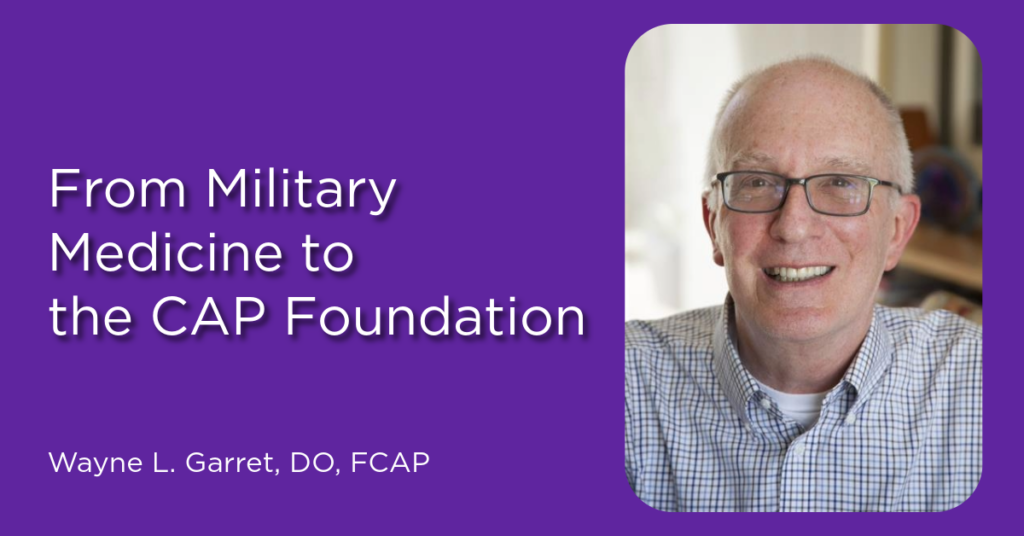
For Wayne L. Garrett, DO, FCAP, a career defined by service began with an uncertain future.
During his first year of medical school, Dr. Garrett received a scholarship from the Masonic Lodges. As he looked ahead to his second year, however, he did not know how he would afford to continue his education.
At the same time, the Vietnam War was ending, the military draft of physicians had ceased, and the US Department of Defense was facing a significant shortage of active-duty physicians. To recruit medical students, the department established a scholarship program that covered tuition and provided a monthly stipend. In exchange, recipients agreed to serve one year on active duty following their training for each year of tuition support they received.
For Dr. Garrett, the program offered both financial security and a path forward.
“It solved my financial insecurity and ensured that I had enough resources to graduate,” he said.
That decision marked the beginning of 33 years of active and reserve military service, and lessons that would influence Dr. Garrett throughout his career as a pathologist, a leader, and a supporter of the next generation.
Learning to Put the Team First
One of the most important lessons Dr. Garrett carried from the military was the understanding that success is rarely achieved alone.
“The biggest lesson from military service is learning that you are part of a ‘team’—or, in military jargon, a ‘unit,’” he said. “Your success is not necessarily measured just for yourself, but on behalf of the unit.”
That perspective shaped how he approached leadership. Decisions were not based on personal recognition or advancement, but on what would best serve the military, the unit, and the broader community.
Military leadership, Dr. Garrett explained, was earned through consistent performance and a commitment to ensuring the unit worked for everyone. It was an approach that translated naturally to medicine, where every decision can affect not only an individual patient but also colleagues and the wider health care community.
Service also taught him how to navigate change. Like medicine, the military continually evolves in response to shifting priorities, personnel needs, funding challenges, and outside influences. Learning to adapt to those disruptions helped prepare him to manage the changes and uncertainties that arise throughout his medical career.
Practicing Medicine in the Military
Dr. Garrett remembers the strong communication he experienced among medical staff in military facilities. Without the same focus on billing, insurance restrictions, budgets, or investor expectations found in other health care settings, the medical team could concentrate on a shared priority: caring for patients.
Yet military medicine also required sacrifice.
Physicians were responsible for duties beyond patient care, and the needs of the military could alter the course of their professional development. A physician might be assigned to provide general surgical pathology services, for example, rather than immediately pursuing a desired fellowship.
For medical students considering military service, Dr. Garrett recommends carefully weighing both the opportunities and the obligations. Military training can provide the chance to travel, work alongside physicians from across the country, and take on greater patient-care responsibilities earlier in one’s career. At the same time, it requires flexibility, sacrifice, and an understanding that personal plans may sometimes take second place to the needs of the mission.
Turning Support Received Into Support Given
The financial assistance Dr. Garrett received during medical school did more than allow him to complete his education. It shaped his belief in the importance of helping others access the same opportunity.
“I was very blessed in receiving support during my educational years from the US government, allowing me to finish medical school without significant debt or disruption because of a lack of funds,” he said. “I know only too well the stresses of finding financial resources during your training years.”
Today, Dr. Garrett continues that legacy of service as Chair of the CAP Foundation’s Development Committee. In this role, he helps advance the Foundation’s philanthropic efforts and strengthen support for medical students, residents, and pathologists at pivotal stages of their education and careers.
For Dr. Garrett, the connection between military service and the CAP Foundation’s mission is clear. Both are grounded in teamwork, shared responsibility, and a commitment to something larger than oneself.
“I think it is absolutely essential for those of us who have passed through this gauntlet to provide assistance to the students and residents who follow behind,” he said.
Through awards, training experiences, mentorship, and educational opportunities, the CAP Foundation helps remove barriers and give future pathologists the resources they need to move forward. For Dr. Garrett, supporting this work is a way to extend the same kind of opportunity that once made his own career possible.
A Legacy Reflected in Others
Looking back on 33 years of military service, Dr. Garrett is especially proud of the people whose careers he helped shape.
Throughout his service, he worked in training facilities and watched individuals he first knew as trainees develop into accomplished and highly respected pathologists. Their success reflects a lesson woven throughout his own journey: an investment in one person can ultimately strengthen an entire profession.
From serving his country to supporting the next generation through the CAP Foundation, Dr. Garrett’s career demonstrates the lasting impact of service, and what becomes possible when those who receive an opportunity choose to create opportunities for others.
Hear Another Perspective on Military Medicine
What is it like to train and serve as a physician in the military today? Listen to the CAP Foundation’s Beyond the Test podcast episode, “From Military Service to Medicine: Finding Pathology,” featuring Couger Jimenez Jaramillo, MD, Maj, USAF, MC. Dr. Jimenez Jaramillo shares how military service influenced her path through medical school and residency, shaped her approach to leadership, and led her to a career in pathology.
More Stories









Why Donate
Every person deserves a diagnosis. Support care beyond the microscope. Expand access to pathology-locally and globally.